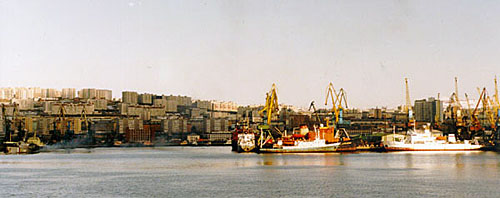
The port of Murmansk is situated in the Kola Inlet of the Barents Sea, between the capes of Mishukov and Abram. It has communication with the rest of the country by air, rail, motorways and the Arctic Sea Route.
The commercial port of Murmansk handles various import and export cargoes. The exports are mostly dry ulk cargoes which are products of industrial enterprises of the Kola Peninsula. � large share in the traffic belongs to Khibiny apatite concentrate which is noted for � high content of phosphoric anhydride and Kovdor and Olenegorsk ironore concentrate. Other export shipments via the port of Murmansk are carbamide, sleepers, otton, fabrics, various manufactured goods and food including containerized cargo. The main destinations of export traffic are Baltic ports, Norway, Cuba, the USA and Canada.
There are n� steady import cargo flows in the port.
The most stable import traffic is fish products from Iceland. The port of Murmansk ships
various cargoes by the Arctic Sea Route to destinations along the Arctic coast of the
Soviet Union, while products of the Norilsk Group of Mining and Metal-Working Enter-
prises arrive in Murmansk for customers of the Kola Peninsula and other areas.
Is specialized in the handling of apatite concentrate
It includes the following major elements:
� railway gallery with two bridges for discharging of special tipping cars;
� � bunker-type mechanized shed with � capacity for 25,000 t of concentrate;
� berth No. 19 for ships with � length of up to 180 m and � draught of up to 9.7 �;
� two reloading machines on the berth, with � capacity of 1,200 t/h each;
� � system of subterranean and on-land carriers and pouring stations;
� the control panel of the transhipment complex.
The main technological patterns used for transhipment
of apatite concentrates are: rail car - storage place; storage lace - vessel.
Is specialized in the handling of general cargoes and ironore concentrate exports
Didestinations: Spitsbergen Island, Dudinka and other places on the Arctic coast.
The facility comprises 5 berths equipped with portal cranes. Two berths (Nos. 13 & 14) can load/discharge using straight technology: rail car - vessel, or vessel -rail car. Other berths widely employ FLTs, roll-trailers and trucks which deliver cargoes to the operating area of portal cranes.
Is specialized in the handling of dry bulk and general cargoes
The facility includes general-purpose berths. Berths Nos. 4 to 7, 9 and 10 can operate on the direct technology: vessel - rail car or rail carvessel. All ships arriving in the commercial port of Murmansk, regardless of the flag, are accepted for handling in turn. The port has open storage space and sheds for cargoes that do not require special temperature or humidity conditions and are not dangerous. Furthermore, the port has � special mechanized bunker for storage of 5,000 t of apatite concentrate. The port operates modern high-capacity machines: "Sokol" and "Kondor" cranes of 16 to 40 t and 500 to 600 t/h capacity; Japanese- and Swedish-made FLTs of 1.5 to 32t; port tractors and roll-trailers of 60 t for the haulage of containers.
Navigation is year-round in the port
in severe winters, the south elbow of the Kola Inlet is
ice-bound for � short time, while in usual winters drif ting ice is observed. The
water level in the Inlet is not stable. Its luctuations are due to tides which changeabout
every 6 hours. The tide is up to 4 meters. In winter the Inlet is foggy and visibility
becomes much poorer, down to zero. The Kola Inlet is safe for navigation, with the
exception of shoals of the Anna-Korga bank.
While approaching berths, navigators should take into account the state of currents. Currents between berths often have � direction of flow differing from that observed in the middle of the Inlet.
Traffic in the port is controled by the "Raskat" shore-based radar station which is particularly helpful if visibility is poor. Ships may enter or leave the port around the clock, all year-round.
Anchorage points for ships of any size are in the south elbow of the Kola Inlet, between the Capes of Mishukov and Abram, west of the Kiyevarakskiy range. The depth is 20 to 35 � there. The anchor ground is good.
It is worth noting that there are several trenches of 40 to 62 � near the middle of the Inlet. If the anchorage is near the western coast, one should bear in mind that the Inlet's bottom raises sharply towards the coastline and that � shallowing littoral shoal begins just after the 10-meters iso- bath.
to any berth is done with the help of tugs.
If winds are above 14 m/sec, all shiftings in the port and on roads may be performed with the permis- sion of the Harbour Master.
In order to provide for safe navigation in the port harbour in any weather conditions, the "Raskat"shore-based radar station keeps � round-the-clock watch.
Ships arriving at the port from the sea shall contact
the station and follow its recommendations in respect of manoeuvres. The
station will help the ship to safely ����� at its
berth or anchorage.
Departing vessels, as well as ships changing position, shall request in advance permission to manoeuvre from the Traffic Control Division (TCD). The TCD shall provide Master with the following information: the ship's deviation from the channel axis (accuracy up to 25 m); distances to floating objects, turning points and meeting vessels (0.5 angle accuracy and distance accurancy up to 25 m); intentions of other ships and recommendations as to appropriate action; on the drift of the ship at anchor.
The "Raskat" station's service range embraces
an area limited by the parallel of latitude of ���� Mishukov in the north and the
borderline of the fishing port in the south.
is compulsory for all ships entering or leaving the port, or shifting in the port. Highly qualified pilots are assigned.
In usual conditions, � pilot is taken on board in the area of the Tiuva Gulf, which� the Pilot Station base in the Kislaya Gulf.
In stormy weather, when embar-kation or disembarkation of � pilot is impossible in the area of the Tiuva Gulf, it is arrangeable south of the Salniy Island, in the area of the Retinskaya Gulf. Pilot services shall be ordered via Inflot Agency or Transflot within the following time limits:
- by � vessel proceeding to the port, 24 hours prior
to arrival at the port, with � more precise notice 8
hours prior to arrival at the Pilot Station;
- by � vessel intending to leave the port, 6 hours in
advance, with � more precise notice 2 hours prior to
departure;
- by � vessel to be shifted within the port, 2 hours
prior to the shifting.
Pilots are assigned as orders are received.
Ships failing to give an order for pilot or being late in doing so, shall be served last.
The Pilot Station and Pilot Boat shall be called while
approaching the Kola Inlet at VHF Channel 16, working Channel 14. The call
sign of the Pilot Station is "Kislaya-Radio-1".
The call sign of the PilotBoat is "Lotsman".
Following provisions of � Resolution by the International Maritime Organization (IMO), the port of Murmansk exercises control of ships in respect of their compliance with requirements of international instruments aimed at protecting life at sea and providing for safety of cargo and seaworthiness of ships as such.
The control of ships meant to secure safety of
navigation is charged to the Port Control Inspectorate which employs qualified
��perts.
serves transport vessels in the port. It takes care of
pilotage and mooring, serves the roads, and maintains � clean harbour.
Sea-going tugs of 1,200 h.p. and 2,310 h.p. take ships to
or from � berth.
Bunker boats supply fuel and lub oils both to Soviet and foreign vessels. Reefer supply boats deliver cargo on board ships riding on roads, as well as to outports in the Kola Inlet.
� reception and stripping facility serves to receive bilge waters from ships for their settling and purification, as well as to strip and wash ships' cargo tanks.
The port harbour is maintained in � clean state with
the help of oil/garbage skimmers of 135 h.p. The port fleet also comprises
comfortable boats for 180 or 80 passengers.
The port of Murmansk has various kinds of communication facilities.
The automatic telephone station serves customers on the port territory and ships at � berth.
The "vessel-shore" communication is
maintained by the Central Port Radio Station. Portable radiosets are much in use for
marshalling rail trains and mooring operations.
The telex service is country-wide.
Computers are in wide use in the forwarding and planning departments. The port's Information andComputer Centre operates around the clock (including Sundays and Holidays). It offers information on vessels staying in the port, availability of cargoes, arriving rail cars, etc.